July 7th, 2010 § § permalink
from POPULAR SCIENCE
July, 2010
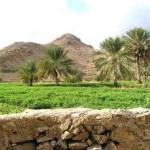
hen asked to imagine the Earth in 2040, many scientists describe a grim scenario, a landscape so bare and dry, it’s almost uninhabitable. But that’s not what Willem van Cotthem sees. “It will be a green world,” says van Cotthem, a Belgian scientist turned social entrepreneur. “Tropical fruit can grow wherever it’s warm.” You still need water, but not much. A brief splash of rain every once in a while is enough. And voilà—from sandy soil, lush gardens grow.
The secret is hydrogels, powerfully absorbent polymers that can suck up hundreds of times their weight in water.
Hydrogels have many applications today, from food processing to mopping up oil spills, but they are most familiar as the magic ingredient in disposable diapers. The difference with agricultural hydrogels is that they don’t just trap moisture; they let it go again, very slowly, almost like time-release medication, into the root system of plants. That continuity of moisture is what brittle landscapes like deserts need to become fertile again. Water activates a mineralization process, setting free nutrients in the soil so that life can grow.
March 11th, 2009 § § permalink

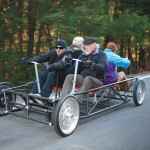
Chuck Greenwood getting it done in Bend
Wind, solar, tidal—all are battling for the renewable-energy crown. But what about the six billion highly efficient short-stroke engines in our midst? What about
us
?
From POPULAR SCIENCE
March 2009
Cave Junction, Oregon, was once, long ago, the center of a gold rush boom that, like so many booms, ultimately consumed its host. Prospectors mined the land around the towns in an ever-tightening circle, until the only gold left was below the saloons, assayers and burlesque halls. Those fell next. The towns were mined right out from under themselves—with no trace left of the old frontier burgs but scars in the earth.
The people who trickled back, decades later, came to satisfy a different urge: not to pursue something but to escape it. Certain hardy members of the hippie diaspora of the ’60s realized that you could live out here entirely under the radar and off the grid. With no one to badger you, you could pursue your own idiosyncratic dreams. You could, in fact, quietly build your better mousetrap and wait until the right time to spring it on the world—the very moment when the world needed saving.
May 8th, 2004 § § permalink
and other rallying cries from the fringes of the final frontier
from POPULAR SCIENCE
May 2004
UC Berkeley space scientist Greg Delory devoured Carl Sagan’s books as a kid; now he hunts for extraterrestrial water—and life—in the solar system. Jeff Greason learned to pick locks at Caltech, from none other than Richard Feynman; now he burns LOX (liquid oxygen) in engines built by his California rocket company.Alexander Poleschuk spent six life-changing months aboard the space station Mir; now this Russian ex-cosmonaut obsesses over his nation’s lofty space goals—and its inability to pay for them.
Three men, three visions of space exploration. As NASA scrambles to recover from the Columbia tragedy, the next phase of spacefaring has already begun. It’s an era marked by new philosophies and agendas—and, according to Rick Tumlinson of the Space Frontier Foundation, a space-travel advocacy group, by three types of space adventurer. There are the Saganites, who yearn to comprehend outer space; the O’Neillians, who want to colonize it; and the von Braunians—who just want to get there first. Welcome to their worlds.
Read the whole article here:
www.popsci.com/military-aviation-space/article/2004-05/my-rocket-going-get-you-leo
March 21st, 2003 § § permalink
Geographic profiling pioneer Kim Rossmo has been likened to Sherlock Holmes; his Watson in the hunt for serial killers is a digital sidekick — an algorithm he calls Rigel.
from POPULAR SCIENCE
March 2003
Until he was called in on the Beltway Sniper investigation, Detective Kim Rossmo’s most confounding case was the South Side Rapist. For almost a decade, an unknown assailant,
his face bandit-wrapped in a scarf, had been stalking women in quiet Lafayette, Louisiana, and then assaulting them in their homes. He remained at large in 1998 when Rossmo, then
a detective inspector with the Vancouver Police Department in Canada, was called in to help. The police were under pressure. The town was hungry for an arrest. There was a glut of raw information. But after a couple of thousand tips and close to a thousand suspects — numbers that would be dwarfed by the 15,000 tips a day that the sniper case would generate, but a sea of data all the same — investigators were no further ahead.
Rossmo’s job was to help direct the manhunt. If he couldn’t find the needle, he hoped at least to radically thin the haystack. And he would do so through the careful application of that most powerful of investigative tools: a mathematics equation.
January 1st, 2003 § § permalink
Two angles on the world’s most dangerous high-altitude stunt
from POPULAR SCIENCE
January 2003
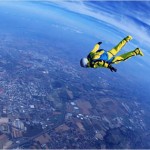
In the middle of the plate-flat Canadian prairie, not far from where writer Raymond Carver hunted geese, a flurry of activity broke out last September around a small, rural airfield. Here was ground zero for French skydiver Michel Fournier’s audacious attempt to ride the pressurized gondola of a helium balloon to 130,000 feet-the cusp of space, the highest anyone has ever gone without a rocket-and topple out earthward. Diving into a near-perfect vacuum he would, in 31 seconds, hit 670 mph and slam into the sound barrier, the first human being to do so with his body. If all went well-a big if-he’d free-fall for just under 5 minutes before his chute delivered him to the ground.
The helium truck had moved into position in the adjacent canola field near Saskatoon, Saskatchewan. The doors to a hangar yawned open, revealing a phone-booth-size, airtight gondola ready to be moved onto the flatbed launch truck. An ambulance stood by in the event of catastrophic failure of any components-the balloon, the gondola, the parachute couplings, the oxygen supply, the partial-pressure suit, the supple oversuit designed to shield Fournier from freezing atmospheric temperatures. After two weeks of dashed hopes, it looked as if Le Grand Saut -The Big Jump-just might happen. All the ghoulish handicapping of Fournier’s chances of coming down alive had ceased.