From Explore magazine, August 1999.
Quinton Gordon photos
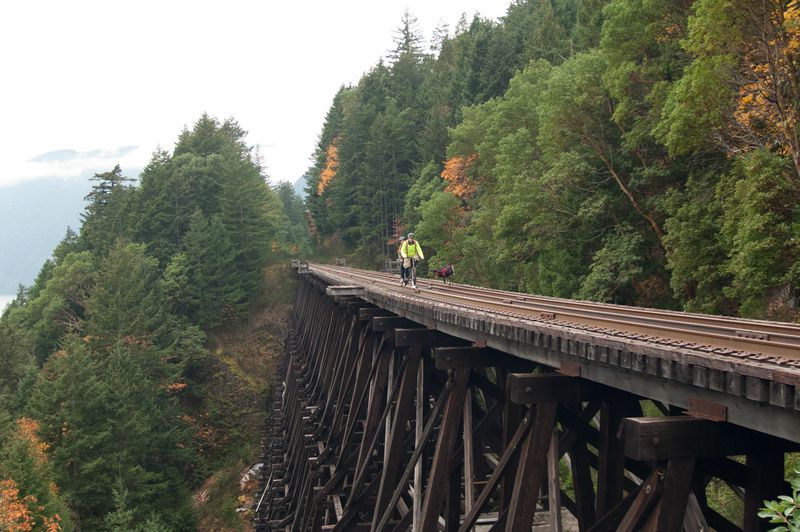
When you look at a grand old railway trestle from afar, it’s impossible not to feel something stir just there, below the sternum. The little matchstick beams crosshatch the sides of the bridge, and the whole effect is so delicate and spiderwebby, it seems an astonishing engineering feat that the structure can support a train’s passage over a chasm hundreds of feet deep while those aboard tranquilly sip their drinks. But try to cross one on anything but a train and you’ll enter into another kind of experience. Oh, you’ll feel something stirring below the sternum, all right: naked fear. Not only are you way, way above the ground, there are no guardrails.
The good news for us, on this crisp day in October, was that no trains would be coming along any time soon. This is because the trestle was condemned. The question was whether it would hold the railbike, though we were fairly certain it would. There were some rotting timbers, and in places damaged ties left gaps you could peer through, down, down. But it felt solid. The sweep of mountain across the pretty lake on Vancouver Island would have made a great Hey-Martha photograph if either my pal Drew or I had had the nerve to take a hand off the handlebars, which we didn’t.
The exposure revved our hearts, no matter how many mind games we played to prevent it. Random thoughts descended: To do this on a live track is probably a rite of passage to manhood in some doomed cultures. Drop anything up here—the pack, a crucial nut, ourselves—and this strange little adventure is done.
The sport of railbiking is the sort of thing that lodges in your imagination the moment you hear about it. For devotees, it crystallizes in crude plans you can buy through the Net, and comes to life in suburban garages, amid the clank of metal and the fizz of spot welds. To say it is a niche sport is to understate the matter; there are, by one reliable estimate, around 200 serious recreational railbikers in North America. And though it’s becoming more common in Europe, railbiking will be hard-pressed to upgrade its way-off-Broadway status, for reasons that will soon become clear.
But railbikes have some uniquely cool attributes. Like that handless riding: you can clean the bugs off your glasses without missing a beat. You can keep a roaring clip, in theory, because you never encounter a real hill. When you get on a bicycle built to ride on railway lines, you can go places cars can’t, see things few humans ever encounter wild and up close. Like?
“Wolves, cougars, foxes, badgers, deer, and, let’s see: 14 bears.” Dick Smart, a dentist from Coeur d’Alene, Idaho, was recalling a single trip through Northern British Columbia. “It’s silent, so you can come right up on them and look them in the eye. On a rail corridor there’s a whole different wildlife perspective; there’s foliage around the track, so the animals have a little cover when they cross.” Periodically he’d run into hobos out there, heard their tales from a vanishing culture. That particular trip, 550 kilometres over 11 days, accounts for but a tiny fraction of the distance Smart has logged on a railbike. It is an Earth-girdling 52,000 kilometres, a Gretzky-like tally among railbikers, who regard him as The Dean. When I reached Smart he was heading out back to tinker with his custom “suitcase” railbike that folds into a case and then magically pops open at its destination. He was adapting the bike for the quirky narrow rail gauge of Patagonia.
If you found yourself sitting next to Smart on the bus, and he started talking about this strange hobby of his, and maybe brought a couple of pictures up on the iPod, chances are you’d be doing some serious recalibrating by the time you reached the office. (At the very least how to angle for more vacation time, and a vehicle that can take a railbike on the roof.) Smart’s patter on the subject is so spellbinding you might forget even to consider a question you really ought to be asking: What about trains?
It’s unsettling that some railway employees call railbikers “Darwin bait.” But Dick Bentley, another veteran railbiker, from upstate New York, put my own fears, at least, to rest. “If you’re careful and watch yourself, you never see anything,” said Bentley. “In an extreme emergency you can just lean in the direction opposite the outrigger. You sort of fall in slow motion. You replay your life story in your mind three or four times.”
I first heard about railbiking years ago on an airline flight (the guy hadn’t done it, but knew someone who had). And not long after I paid a visit to Chris DeKerf—whom you could call The Dean of West Coast custom bicycle building without starting a flame war. Chris headed the handbuilt division of Rocky Mountain bicycles before he struck out on his own. At his shop in Richmond, B.C., bikes in various stages of completion hung in racks. (Including one, for a Colorado surgeon, who asked that his paint-job look like “a glass of Guinness, with foam.” It did.)
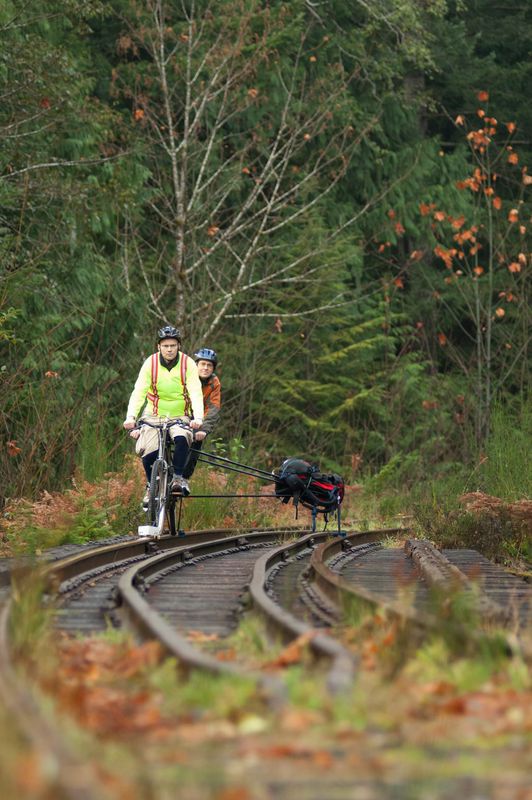
Chris is not a man to avoid a challenge, but he needed data on my strange proposition. How had others built their rigs? It turns out there’s virtually no end of design variations for the wheels alone—from paired, flat-sided rings that enclose the tracks to a superwide front tire you just free-ride on top of a rail, on the theory that you could walk even on the blade of a knife if you had a fat enough pair of shoes. There have been railbikes with sails and railbikes with sidecars for passengers or canoes. Dick Bentley’s position is that you want to work with a proven set of plans, rather than just Red Green-ing it. And the design he’d mailed me had kept his own bike on the Adirondack Railroad track for decades through pretty straightforward means. You ride on one rail, an outrigger extends across to a wheel that rides on the other. A guide mechanism keeps the front tire going straight, and Bob’s your uncle.
Except that I’d bought a tandem, which neither Bentley’s designs nor anyone else’s accounts for. A little muscle twitched at Chris’s temple when I wheeled it in. I thought I heard some module in his right brain powering up. This was already fun, though Chris had yet to turn a single screw. The whole enterprise felt like Neil Young converting his Lincoln Continental road pig into a battery-powered electric with a biodiesel backup. It felt revolutionary, even though it really isn’t. Because railbikes have been around almost as long as there have been rails.
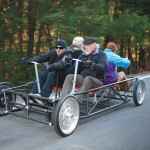
In the early days railroad companies (and telegraph companies, whose wires ran along the rail corridors) used railbikes to get maintenance guys out to remoter reaches, and many of them kept one in the baggage car like a lifeboat: in case of a breakdown the brakeman could ride for help. By 1908 you could actually buy a railbike kit in the Sears & Roebuck’s catalogue, for $5.45. The ad sat nestled between frontiersmen’s revolvers and magic-lantern projectors and the first phonographs—as if these technologies all had a bettor’s chance of taking the world by storm.
Railbiking fused the railway boom with the bicycle craze: a promising marriage. The problem for recreational railbikers was that there were just too many trains. It would take 70 years or so before a kind of sweet spot appeared—when rail travel was in decline but no one had got around to turning the tens of thousands of kilometres of neglected track into razor blades. (And there wasn’t yet, as Dick Smart puts it, “an attorney lurking behind every tree.”) There was a spell, in the 1970s, when a cool railbike design could land you in Popular Mechanics. One 1976 feature, running under the banner “It’s New Now,” showed a gentleman in a sportcoat rising out of his saddle, all techno-chic against fields of waving grain.
That was the time the modern popularizers emerged, including the two guys named Dick, all following the lead of The Founding Father of the modern era of railbiking—The Dean of Deans—a Canadian, no less, named Florian Grenier. Grenier, who died a couple of years ago, had a railbike on the tracks before the Allies had troops out of Germany. He was a marathoner, building a bike “with enough room to carry gear and grub” for weeks in the bush. He once rode 381 kilometres of BC Rail track between Chipmunk and Fort St. James—roughly the same route Dick Smart would later follow and call “the greatest adventure of my life.” Grenier proved that railbiking is really, foremost, about doing your homework.
“Florian was supposed to come with us but had to cancel at the last minute,” Dick Smart says. “But I used all his information because he was so good about mapping out the trip and knowing where we could get to.”
You’d think that that homework would be easier now, in the age of Data Smog, but it isn’t. There are no up-to-date atlases of abandoned track. “You can’t write a book on it because things change so quickly,” Smart says. “By the time you learn where to ride the track’s gone.” What’s left is spadework. “I call libraries and fire stations in the middle of nowhere and ask them if their tracks are still there and in use.”
Of course there’s the Net, but because the railroad companies are as eager as anyone to know where the bandit fish are jumping, you won’t get the real goods on pirate riding if you just Google “railbiking.”“We’ve gone underground, basically,” Smart says. There’s a website run by Peter Hoffman, founder of Bicycle magazine, but it’s impossible to find. “We have a code word for it,” Smart says. “There’s like 20 of us who belong.”
On a fall day in 2005 the call—actually an email—came. “Interested in a railbike?” said Chris Dekerf. “I happen to have one.”
It wasn’t finished finished, but it was ready to be tried: a prototype, the X-1. It was fairly beautiful. The outrigger tripoded down onto a skateboard wheel. He’d made the whole front-end weatherproof: stainless steel with brass bushings, and aluminum skid plates like a cow-catcher to kick the whole rig up in the event of a collision. To stop the skid-block from dragging, there was a hand-carved “lift-rod” mounted on the handlebars, so the rider could “fine tune” the guide-wheels while riding, keep them low enough to grip the rail but high enough to stay out of trouble.
“You’ll be amazed at what’s stuck on the side of rail lines,” he said. “There are cables, there are bolts.” There are also “greasers” that stick up and, activated by the weight of the train passing atop them, pump grease onto the wheels. “You hit one of those things at a good speed,” Dick Smart had warned, “it’ll stop you.” Higher up, the seams between the rails aren’t always tight. A half-inch gap is nothing to a train, but it’s enough to send the rider into orbit.
“Crashing is nasty,” Chris said. “If you come off at anything over 15 kilometres an hour, it’s ugly. This design minimizes the problem, but no matter how well the bike’s built, you can’t fully avoid accidents. You just don’t know. At some point, I think it’s safe to assume, you will come off this bike.”
Up in his office, Chris produced a liability waiver.
“Have you ever had to make one of these things out before?”
“Never.”
The railbike had taken Chris “probably 10 times longer than I thought” to build, and if he heard a call coming in asking for another one, he might pretend to be in Phoenix, indefinitely. And yet the project had lodged in him—like a deer tick, but in a good way. Chris had made a railbike you can assemble with a number-five Allen key, folding up the outrigger and bungying it to the frame. He was proud of it. He just wasn’t so sure about me.
“Don’t get yourself, or anyone else, killed on this, please,” he said as I shook his hand. “Then I’ll want my stickers off it.”
We tested the X-1 on a rusty urban rail line that slices through the tony heart of Vancouver’s West Side. (Since the CPR stopped running trains here five years ago, the corridor is used only by coyotes and raccoons in their nocturnal commutes.) Drivers slowed and stuck their heads out the window to gawk. “What is that? Did you guys build that? Hell of an idea!” Within 90 seconds of our actually getting the bike on the rails, three little kids materialized, and they were quick to diagnose problems: “The seat needs to be higher.” “The tires need more air.” A bigger issue, it turned out, was that the outrigger was light—if we leaned at all away from it it lifted, and once we crashed that way. (On an actual ride the weight of the pack would hold it down—we hoped.) Plus which, I’d brought the wrong wrench, so couldn’t adjust the guide wheels properly. The kids ran along beside us as the sun went down. They tried to organize another play date so we could all try this again.
The second test, a month later, was more promising. Chris had made adjustments to the X-2. A sandbag kept the outrigger down on the rail, but the rig, heavy to begin with, was now a bear to move. Couples, children and people’s aunts on one-speeds were overtaking us on the parallel service road. We were sweating like donkeys. I took off my down vest and strapped it to the outrigger, where blackberry canes sliced it to ribbons, and then it tangled in the rig, stopping us as abruptly as a drag chute.
In places the outrigger suddenly and inexplicably went off the rail—and when it did, with the weight of the sandbag on it, it slammed down hard and bucked us off. It became clear that the width between rail lines vary by as much as a couple of inches. How could that be? You’d think that measurement would be perfectly consistent, maintained to vanishing tolerances by an expensive machine—but apparently some co-op student was eyeballing it.
Not only that, from time to time our perfectly adjusted guides would suddenly start tightening up, slowing progress to a crawl. Turns out the width of the rails themselves varies wildly, as the weight of trains over time squashes and spreads them like a pie crust. This is something you don’t quite believe until you’ve seen and felt it. Train wheels allow a huge margin for error in this. They float, shimmy-shammying back and forth, bumping back toward the middle when they drift too far, like a blind man in a supermarket aisle.
As we approached a road crossing another issue loomed. Our great brainwave was to adapt a tandem bike—double the power, double the fun. But the tandem was so long it needed a back guide as well as a front, and our back guide was fixed. Which meant getting off and walking the bike across pavement. At one point the grade levelled out, and began to descend. We got some speed up. Then: Boom. A seam between the rails caught the rear guide, and the shock was conveyed up through the frame directly into the huevos of the two riders.
We travelled three kilometres in 2 1/2 hours. As Drew helpfully pointed out, “We could have walked this same distance probably three times.” But we were railbiking, baby! With a little tinkering we’d be ready to log some serious mileage, Out There, where the signals of the city die. The bike went back into the shop for some final tweaks.
Cut to: a calendar, its pages turning. At intervals, when I called, Chris seemed to have all-but finished with the bike, and at the same time was unwilling to give up. “Let me go another round with it,” he’d say. The X-3 became the X-4.
By the time the bike was finally ready, almost five years had elapsed from the time I’d first approached Chris.A lot had changed. Chris had bags under his eyes that I didn’t remember seeing before. We had both become parents. Different things were important now. Back when we started, I was better able to contemplate a lifestyle in which railbiking actually fit in—a nimble, low-overhead, light-out-for-the-territories-when-the-mood-hits kind of thing. And he was better able to imagine sinking endless hours into a weird lark that didn’t pay the rent.
Railbikes are a consummate do-it-yourself project. They depend on the same “fly-a-little, test-a-little” ethic that is driving the private rocket builders in Mojave to build a space-tourism industry. In this respect, it’s kind of sacrilege to have someone basically build one for you. But that disconnect between builder and user was only one of the things that had held Chris up.
“I’ve figured out why I’ve struggled so much with this,” he said, as we lashed the bike to the roof of the car. It’s because he is a perfectionist. His impulse is to do one thing at a time, do it very well, and then move on. He was able to scratch that itch with the front guide, its delicate machining. But railbikes are not bikes, and tandem railbikes are off the map. There’s nothing to compare the work you’re doing to, and no way to anticipate all the potential problems, and no literature on them even if you could.
“ When I got frustrated,” Chris said, “I just reminded myself, it doesn’t have to be perfect. It just has to work.” It’s hard to imagine that more professional expertise has ever gone into a railbike.
NASA had done all it could. Now it was up to the astronauts.
It would tax an FBI profiler to come up with a “type” of person who railbikes, since the sport is full of contradictions. There’s a greeny, save-the-planet dimension to it that would seem to attract progressives. Yet the image of the lone frontiersman, pursuing a simple pleasure, asking nothing but freedom and shouldering what comes, is textbook libertarian.
If you’re a railbiker, you’re probably a gearhead, comfortable around power tools; you may be a history buff, and probably a railroad enthusiast; you hold strong opinions, and love nuggets of historical trivia, like the one posted on Dick Bentley’s railbike webpage: Why is the standard railroad gauge in North America such a weird number: 4 feet, 8.5 inches? The answer goes back to the original specifications for the Imperial Roman war chariots, which were made just wide enough to accommodate the hindquarters of two war horses. That funky rail width, the railbike enthusiast notes, determined the size of the engines that power the Space Shuttle. Those big boosters have to be shipped by train from the factory in Utah to the launch pad, and they have to fit through a couple of tunnels, which are only slightly wider than the track. “So, a major Space Shuttle design feature of the world’s most advanced transportation system was determined over two thousand years ago by the width of a horse’s ass.”
Railbikers can be obsessive. Whenever he’s on vacation, and driving over a rail crossing, a man named Dom Bencivenga told me that he instinctively looks for rust on the line—because rust means no trains and no trains means railbiking. Never mind that Bencivenga, who once built a recumbent railbike, no longer rides. (Not since his little-used stretch of line in Erie County, Pennsylvania, was bought by a shortline rail operator from New York, and many trains now ply the route.) It’s enough that he could. A railbiker is always recovering, never recovered.
Bencivenga “had the bug bad,” he admits; but his friends did not share his enthusiasm. And that’s why railbikers make up a weirdly oxymoronic group: a community of outliers.
“It is lonely,” Dick Smart told me. “It’s a sport you have to kind of keep inside yourself. It’s not like you can go into a bar and share railbike stories, because nobody knows what the hell you’re talking about.”
If you’re a railbiker, you’d better be thick-skinned, and able to tolerate the feeling that around the next bend may well be someone who really, really doesn’t want to see you.
“In 31 years I’ve been stopped a dozen times by people in high-railers [track-inspection vehicles] and told to get off—though never thrown in jail,” Smart says. “But I never wanted the same guy to tell me to get off twice.”
In the early days, Smart tried to make a commercial go of it, selling “Railcycles” of his own design, but liability issues put an end to that. “I formed a corporation and did everything I needed to do. I had people sign their life away. But still I had railroad officials treating me like I was making an AK47 or something.” He dropped the business plans and simply tried to ask permission to ride on abandoned lines. Which is easier said than done. How do you tell who owns the land, when tracks pass through streets and public parks? Again and again he was refused. Finally he threw up his hands, and a semi-organized outlaw railbiking ethic was born. “It’s easier,” he says, “to seek forgiveness than it is to seek permission.”
Other entrepreneurs like Smart have tried to develop organized railbiking in Canada, but everyone has been crushed by government red tape and liability issues. So Drew and I pretty much had no choice but to be renegades—albeit of the bespectacled, pencil-necked kind.
For a number of reasons, an awful lot of rail has been removed across the country in the last 10 years. But that still leaves thousands of kilometres of non- or lightly used track that is simply catnip to a railbike like the DeKerf X-4. We zeroed in on one of the most inviting stretches, the Esquimalt & Nanaimo (E&N) line, which snakes halfway up Vancouver Island. Inviting for its landscape—ocean, mountains, pastureland, high trestles over plunging gorges—and its history. (The true “last spike” on the CPR was pounded in not at Craigellachie but here, at the village of Cliffside, a little north of Victoria.) Best of all, it is barely used. Freight mostly stops moving on weekends, and a single passenger train goes the distance once-daily. Perfect.
“You’re not getting on that track until you show me the schedule with what times that train leaves,” my wife, Jen, said. She made it clear she was going along with this plan only under duress. Drew, too, was having misgivings. We are aging men who enjoy staying alive, and are supposed to be modelling responsible behaviour to our kids.
There was another way. Off of the main Victoria-to-Courtney line, a branch extends westward from beachy Parksville, over the mountains, to Port Alberni. The tourist steam train that chugs the 10 kilometres to Port Alberni’s historic Mclean sawmill was down for the season. The track is otherwise empty, and has been for six years.
In the morning mist of an October Sunday, sleepy Port Alberni was positively comatose. The plume from the pulp mill hung like a pall. The three mills on the harbour were all operating at way below capacity because of the depressed market for wood. It was easy to imagine a railbike-tour operation spiking the place’s metabolism a little.
Fifty-five kilometres of riding lay ahead. We’d power north to the sawmill, then follow the rail east, through bear country, past the old rail stops of Bainbridge and Bostock and Stoke, climbing the three per cent grade to the summit and then down through the northern hem of mighty Cathedral Grove and on through to Parksville.
We set up next to the Port Alberni train station, and as we did, two cars pulled into the lot, and the drivers exchanged cash for marijuana. This was an extremely good sign. It meant the area was lightly policed.
There’s something vaguely embarrassing about, as an adult, having to skulk around avoiding detection. The CPR gifted this line not long ago to a not-for-profit group called the Island Corridor Foundation, which was less likely than some to release the hounds on us, but it still seemed wise to move quickly along.
Speed! We rolled out of the train station, bound for Parksville. Only to find ourselves—Hello, Cleveland!—half a kilometre down the track staring at a locked fence. And so was born yet another new sport, even more marginal: urban portaging. We humped the rig through downtown Alberni, past brake shops and burger joints. I doubt it looked heroic, but it felt like a real expedition, like sledging heavy gear across the tundra. Railbiking inverts the old equation: the city is the country and the country is the city. The wilderness, laced with those smooth rails, is the zone of comfort and easy mobility; the city, with its fences and switches and progress-stalling traffic lights, is the inhospitable frontier, and the faster you put it behind you the better.
We pitched up finally near a train trestle on the outskirts of town, and plopped down to rest. “You know, if both people weren’t equally on board with this, it’d be tough,” Drew said, shaking sweat from his head. “Because that sucked.”
The way ahead was now clear. But the track itself was a mess. The century-old iron rails were pitted and cracked like old teeth, the outside worn to a sort of pinking-shears edge that seized Chris’s beautifully engineered guide wheels and shook them like a Rottweiler. It may have well suited Dick Bentley’s backyard track in the Adirondacks, but here the limitations of our design were becoming apparent.
Just as Chris had warned, there is no end of little things that can halt progress on a railbike. Some are predictable—like rocks that have rolled down the embankment and snugged against the track—and some not so much. It had rained, and the tracks were slick. And because train rail isn’t flat on top but rounded, if your tire is even a little off-plumb it can suddenly slip off, knocking the wheel assembly out of alignment.
As we sat trying to repair the front guide, we were suddenly aware we weren’t alone.
“You need a flange, eh?”
Bob Jones, a retired logger and heavy-duty mechanic had spotted us from the window of his house near the tracks. Laconic. Feed cap. Hands in his pockets.
The outrigger was providing balance, Jones had noticed, but it wasn’t keeping the bike on track, and a guide wheel with a big lip on one side might do the trick. Actually, he happened to have a few.
Apparently, when you take a train out of a community you create a vacuum that people’s imaginations try to fill. Jones told us he’s been meaning to adapt his snowmobile to run on the tracks. Meanwhile, Ken Wilson, a local electrician and welder, test-drove a railbike his Dad built, from the summit 15 kilometres east of here. “It was pretty Mickey Mouse but it worked well enough,” he recalls. Except that the outrigger couldn’t account for the hiccups in the gauge. The track went wide and the bike didn’t, and Wilson shot over the handlebars. “It wasn’t too good,” he remembers. “Shoulda had a helmet.”
Wilson decided a more skookum vehicle was called for. So he outfitted a little railway pump car with a 12-hp engine. He finished his last weld at midnight and decided to test-drive it then and there with his son and his son’s girlfriend. The car bucked violently to life—the drive system generated far too much torque—and was suddenly away, kerthumping over automobile crossings, picking up speed, hitting at least 50 kpm by the time they reached the trestle on the edge of town. A fine slime of slug guts peppered their faces, and a lawn chair and picnic cooler and the sticks Wilson had rigged for brakes flew off and vanished into the blackness. When they hit the summit, Wilson cut the engine and they all waited for their breathing to stabilize. It was good, but it wasn’t too safe. “Shoulda had a helmet,” he says.
Near Cameron Lake, the air was perfumed with the smell of a controlled burn on a nearby mountainside. It was the kind of setting where you long to feel the wind in your hair. (Drew and I, we longed for hair so we could feel the wind in it.)
But there is no wind without speed, and speed was not part of this afternoon. It turns out that trains are great lawn mowers. Take them away and the land very quickly reclaims a rail corridor. Here the scotch broom was happy to get a beachhead uncontested, and it screamed against the tiny steel cowcatcher as we crawled along. Soon it was as high as our waist. Our neck. Over our heads. It lashed our faces in a way that felt medieval. (This is of course why it’s so tempting to railbike on active track. Abandoned lines on the plains of Saskatchewan are one thing; abandoned lines in a temperate rainforest are another.) We had to stand on the pedals to get enough power. The brief unweighting made the wheels spin.
And so we were thrilled—thrilled!—to arrive at that condemned trestle. It was toothless and scary, but it was also broomless, which made it beautiful, and we nosed along it, toward some kind of lesser immortality.
I will not lie outright and tell you that we railbiked the entire 55-kilometre route. Nor can I claim that forest creatures gathered at our feet as we stopped to drink deeply from mountain springs. We did not so much “glide effortlessly on ribbons of steel,” as one railbiking book promised, as we did grind out yardage like fullbacks. There were bursts of exhilaration punctuated by our standing around scratching our heads.
And yet we came home strangely giddy. It felt like the opposite of failure, just to be out there. You probably couldn’t talk to more strangers in a day if you were handing out 10-dollar bills. You couldn’t learn more about how to do something right by doing it wrong. (We should probably alert Popular Mechanics now that the DeKerf X-5 will be a showstopper.) And all that iron somehow got into our bloodstream. Train rails—bearing their stamped dates of completion—throw you a century back in time. To be a railbiker is to be intimately inserted into the creation myth of our nation. Lots and lots of now-forgotten people laid track to the sea. And on it a whole country grew, developed Rep-by-Pop, the two-line pass rule, peacekeeping, Muskol. And the freedom to at least debate breaking the law, sometimes, just for the hell of it.